


PPWR Part 2 — Recycled content: when does virgin PE and PP demand really change?
From 2030, plastic packaging sold in the EU will have to contain a minimum share of post-consumer recycled plastic under the Packaging and Packaging Waste Regulation (PPWR). For polyethylene (PE) and polypropylene (PP), the targets arrive at a difficult time: European recycling capacity for these polymers was flat in 2024, and total recyclate output fell. The plant closures accelerated further in 2025. For virgin PE and PP producers, the question is when demand will actually start to shift.
This is thesecond article in our series on the PPWR. Read part one, on recyclability, here.
Different targets for different applications
Article 7 of Regulation (EU) 2025/40 requires the plastic part of packaging to contain minimums hares of recycled content recovered from post-consumer plastic waste, calculated per packaging type and format as an average per manufacturing plant and year. Two categories matter most for PE and PP. Contact-sensitive packaging made from plastics other than PET must contain 10% by 2030 and 25% by 2040. Other plastic packaging must contain 35% by 2030 and 65% by 2040. PET contact-sensitive packaging and single-use plastic beverage bottles have separate targets of 30% by 2030, rising to 50% and 65% respectively by 2040.
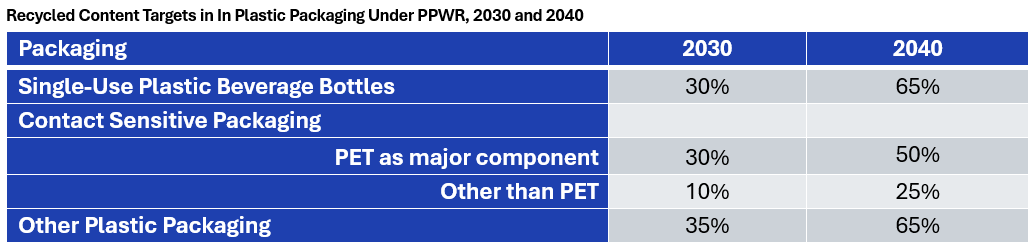
Because PE and PP go into everything from films and bags to bottles, closures and tubs, the target depends on the application, not the polymer. A PP yoghurt pot faces a 10% target in 2030; PE pallet stretch film faces 35%.
The 2030 targets apply from 1 January 2030 or three years after the Commission's calculation methodology enters into force, whichever is later. Exemptions include compostable packaging, certain medicinal and medical-device packaging, and plastic parts making-up less than 5% of a packaging unit's weight. That threshold matters for injection moulders, as small components such as closures and dispensing parts may fall below it.
Recycling supply is shrinking
Europe has an established recycling industry for polyolefins, but it is contracting.
According to Plastics Recyclers Europe (PRE), installed capacity for rigid PP and high-density polyethylene (HDPE) was stable in 2024 at around 1.8 million tonnes and 1.75 million tonnes, respectively. Capacity for polyolefin films, the largest segment, plateaued at about 3.5 million tonnes. Total installed plastics recycling capacity in Europe stood at 13.5 million tonnes, but recyclate output fell from 7.7 million tonnes in 2023 to around 7.5 million tonnes. PRE's preliminary 2025 data show a 50% rise in plant closures, with nearly one million tonnes of capacity lost over three years. Between January and July 2025 alone, almost as much capacity closed as in the whole of 2024, and PRE forecasts zero net capacity growth for 2025.
The decline is attributed to high energy and production costs, weak demand and growing imports of low-priced material from outside Europe.
The European Commission's environment commissioner has described the sector as being in "deep crisis". Much of the problem comes down to price. Cheap virgin resin from new capacity in Asia and the Middle East has undercut recyclate. The oil-price spike in the first quarter of 2026 narrowed the gap only temporarily. Europe is also increasingly reliant on imports, which met 19% of converter demand for circular plastics in 2024, according to Plastics Europe. A ban on exports of plastic waste to non-OECD countries from 21 November 2026 is expected to add to the pressure on the sector.
Quality is a further hurdle for PE and PP, especially where recyclate must meet strict specifications for colour, odour, mechanical performance and consistency. Food contact is the tightest constraint. Under Regulation (EU) 2022/1616, the only recycling technologies currently recognised as suitable for food-contact plastics are post-consumer mechanical PET recycling and recycling from product loops in a closed and controlled chain, such as reusable crates. Mechanically recycled PE and PP from household waste can only reach food-contact packaging through technologies still being assessed. Currently there are no recognised PE and PP supply from mechanical recycling that can be used in food packaging using mechanical recycling.
Chemical recycling, a possible route to food-grade polyolefins, is not yet filling the gap. Of around 65 projects planned in Europe, with about 2.8 million tonnes a year of combined capacity, only 18 were operating by October 2025, producing around 290,000 tonnes. Dow and Mura Technology cancelled a 120,000-tonne-a-year plant at Böhlen, Germany, and ExxonMobil shelved investments at Antwerp and Rotterdam. Mechanical recycling has been more resilient, although Borealis put a planned 60,000-tonne-a-year polyolefin plant in Austria on hold. Some projects tied to the PPWR targets are still going ahead. PureCycle is building a PP dissolution-recycling plant in Antwerp, due to ramp up in 2029, and INEOS is producing mass-balance recycled PP and PE from pyrolysis oil at Lavéra, France. In any case, cost of chemical recycling is significantly higher which would be hard for packaging producers to pass on to final customer.
When does virgin PE and PP demand really change?
According to Townsend forecasts, probably not much before 2030. The targets are not binding until then, and the start date could slip if the Commission's calculation methodology, due by the end of 2026, arrives late. After 2030, the effect will depend on the type of packaging and on how much qualifying recyclate is available.
The biggest effect will be on packaging that is not contact-sensitive, such as pallet stretch film. Food-contact packaging will move more slowly, given it slower target and the lack of approved recycling routes for PE and PP.
The bigger shift could come in 2040, when the targets rise, provided recycling capacity starts growing again.
Nor will every tonne of recyclate displace a tonne of virgin resin. Technical limits, food-contact rules and the price gap will all slow substitution, and changes in packaging demand and design will also shift the balance between virgin and recycled material.
Packaging will also compete with other sectors for recyclate. The EU's end-of-life vehicles regulation, adopted by the Council in June 2026, requires plastic in new vehicle types to contain 15% recycled content within six years of entry into force and 25% within ten. At least 20% of that recycled plastic must come from end-of-life vehicles, so carmakers will be competing with packaging for the rest, including recycled polyolefins. Brand owners such as Unilever and Nestlé are buying post-consumer recycled plastic, although many of the brand owners have lowered or delayed their voluntary targets. Unilever now aims to cut virgin plastic use by 30% by 2026 against 2019 and reached 29% in 2025, while Nestlé cut virgin plastic by 28% against a one-third target for 2025. National plastic taxes push in the same direction. The UK taxes plastic packaging with less than 30% recycled content at £228.82 per tonne (about £0.23/kg), the rate in force since 1 April 2026, and Spain taxes non-recycled plastic at €0.45/kg.
For virgin producers, the targets point to lower demand for prime PE and PP in packaging over time, on top of high production costs and import competition. For converters and brand owners, the immediate task is to secure post-consumer recyclate that meets both technical and regulatory requirements.
The rules are still being written
The PPWR sets the targets but not yet the rules for meeting them. By 31 December 2026, the Commission must adopt three acts: a methodology for calculating and verifying recycled content, sustainability criteria for recycling technologies, which will decide which processes, including chemical recycling, can generate qualifying material, and rules on the equivalence of recyclate from outside the EU. Labelling follows the same methodology. Showing the share of recycled content on packaging is voluntary, but from 12 August 2028, or 24 months after the relevant implementing act, any such label must follow harmonised EU specifications and be based on the Commission's calculation methodology.
The regulation also allows the targets to move. By 1 January 2028, the Commission must assess whether derogations are needed from the 10% and 35% targets where suitable recycling technologies are not authorised or available, which is directly relevant to food-contact PE and PP. It can also adjust the targets if recyclate is unavailable or excessively priced, and must report by February 2032 on the 2030 targets and whether the 2040 levels are feasible. Bio-based plastics do not currently count towards the targets. By 12 February 2028, however, the Commission must review bio-based plastic packaging and may propose allowing bio-based feedstock to count where suitable food-contact recycling technologies are not available, another potential route for contact-sensitive PE and PP.
According to Townsend's Virgin vs. Recycled PE & PP forecasts, European virgin PE and PP demand erosion will start becoming more pronounced in 2030, with momentum slowly building. The pace will depend on whether recyclers can supply PE and PP that is good enough, in large enough volumes, at a price converters will pay.
For more detail on impacts of the PPWR on PE and PP consumption check out the latest Townsend Annual Supply/Demand reports.


