

.svg)
Braskem Pursues Higher Antidumping Duties as Brazil's PE Market Weakens
Braskem Pursues Higher Antidumping Duties as Brazil's PE Market Weakens
Braskem has filed a legal petition challenging Brazil's antidumping duty on polyethylene (PE) imports from the United States and Canada, arguing that the current measures are insufficient to protect the domestic industry. The company is requesting a revision of the duties to the levels recommended by the technical investigation or, alternatively, the adoption of an ad valorem tariff instead of the current fixed duty per metric ton.
According to Braskem, rising naphtha costs combined with lower U.S. ethane prices have widened the competitive gap between Brazilian and North American producers, increasing the incentive for dumped imports.
At the same time, Braskem is increasing operating rates across its production facilities in an effort to expand market share and strengthen cash generation while advancing its out-of-court financial restructuring. The strategy is intended to support negotiations with creditors over its multi-billion-dollar debt under the new governance structure led by IG4 Capital and Petrobras. This operational effort also coincides with Shine's (IG4) tender offer proposal to take the company private as part of a broader corporate reorganization.
PE Imports Highlight the Importance of U.S. Supply
The chart below illustrates Brazil's polyethylene import pattern over recent years, highlighting the significant role of U.S. material in the country's supply balance.
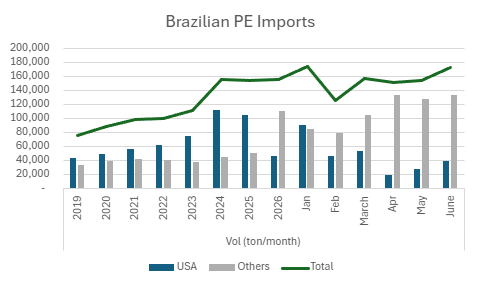
Figure: Brazilian polyethylene imports by origin (USA vs. Other countries) and total imports, 2019 –June 2026.
Based on the data, imports from the United States have remained a substantial share of Brazil's PE imports, even as total import volumes fluctuated. After increasing steadily in recent years, total imports have remained at historically elevated levels, while U.S. shipments continue to represent an important component of Brazil's supply.
The data also show that imports from other origins have expanded, contributing to the high overall import volumes seen in the Brazilian market.
Brazil is the fourth-largest polyethylene consumer in the world, making any change in its trade policy relevant not only for the domestic market but also for international suppliers.
Meanwhile, Brazil's resin market continues to face weak demand. Sluggish retail activity and limited consumption by plastics converters kept order volumes subdued throughout June, while many buyers remain adequately supplied after building inventories earlier in the year during the initial stages of the geopolitical conflict.
Given Brazil's position as one of the world's largest PE markets and the continued importance of U.S. material in its import mix, a revision of the current antidumping measures could have consequences beyond the domestic industry. Higher duties on PE imports from the United States and Canada could alter established trade flows and potentially destabilize international polyethylene trade, affecting suppliers, exporters, and market participants across the Americas.
.svg)
.svg)
.svg)
.svg)


